[ARG] The Pizza Code Mystery

Well, the IRC clues initiated the web-based part of the ARG, and are part of the puzzle trail that led up to the HALOS file code puzzle. But since we still haven’t been able to solve it, it’s difficult to see the whole picture of what the IRC clues really mean and where they are supposed to lead.

However, we know at least this much:

  • IRC clue 1 had the Konami hint that helped us discover the first terminal site.
  • IRC clue 2 had “NOTE WELSH”, which was probably a hint pointing towards Dr. Welsh’s diary log note.
  • IRC clue 3 had a hint for the Navajo code in IRC clue 4.
  • Many of the IRC clues have story elements in them, some more than others, which seem to build up some sort of story.
  • Two of them had code puzzles that revealed further clues, which we don’t know the meaning of yet. They may contain clues related to the HALOS code puzzle, or they may contain clues that only make sense after we’ve solved the HALOS code puzzle (if we ever do).
    What’s interesting is that the comment in qecode.ogg, which was found recently in the Steam release, seems to be related to the solution to the IRC clue 5 puzzle. The question is, why are we being reminded of “BENALOHPAILLIER” again now? Does it mean it’s part of the HALOS code puzzle? Or, does it mean it’s not?

I think that BENALOHPAILLIER has significance for sure. I don’t however think it’s related to the code, but rather what it was originally stated for, the “Halos Files.”

If it was a key for a code, I’d think Horn would’ve said “key for the Halos file is BENALOHPAILLIER.” So maybe there’re more files regarding Halos we have to access first?

Maybe we don’t have everything we need for the Halos code, and we need Halos files, as there seems to be nothing at all that helps us with the code in-game at this point. The weird thing about IRC Clue 5 is that it seems as if it didn’t help solve anything else, just add on to the mystery, seemingly unlike the other IRC Clues. It just leaves me feeling a wrong way. I wish we could know if there’s anything else in-game to help us at this point(in regards to where we’re at, as Storm has stated that there are more “nuggets” of information in the game). Maybe we really should wait for Xen to roll around and find something new, like the person referenced in the qecode.ogg. Or maybe there’s more websites out there we’ve neglected and/or should revisit?

P.S. This whole arg has so many layers I honestly think it might be designed too good. If only I was good at this encryption stuff it’d make more sense. X/

I found this a while back but forgot to mention it here and is both interesting and confusing.

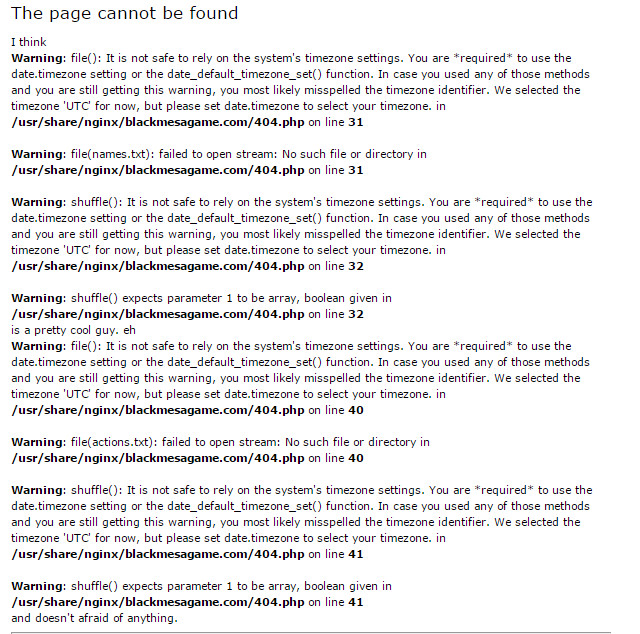
If you open up the console in in your browser, google chrome for example, on the games main website, it tells you about an error and a warning. the warning isn’t interesting, but the error is. It complains about https://www.blackmesasource.com/images/contacts.jpg respond with a 404 error. I tried sharing the link a wile back, but somehow the link broke, so the only way i know how to get to it is via the console. When it was mentioned by someone else a wile back it was a fake error 404 not found page that wasn’t very interesting at the time, but was weird. At that time it displayed a comment saying that the user isn’t afraid of clicking links and below that was quotes and comments by some of the devs and an image that is random and often weird. At the time it wasn’t considered revelent to the arg. But now it has changed and is mostly the same except this:

[attach=4120,none,640][/attach]

The rest of the page is the same. Strange isn’t it? I don’t know if this arg related or not but this is definitely something to note about.

The warnings/errors on the page are caused by server PHP config/script issues. It probably happened as a result of the site getting moved to a new server, or the server was upgraded to a new PHP version, which must have broken the script.

Has Storm confirmed that the comment posted to the “752 Hex Code” page (Titled “Aug 09”) was actually him? If so, perhaps an examination of those numbers could reveal something that might assist us. For instance, we have done nothing with the “1001085139140914” code, and it’s possible that the pattern has some bearing. A similar grouping of four digits can be found at the end of the comment, post the translation of symbols into numbers:

7609 7609 7609 0906 0907 6609 7696 6097 6097 6098

Before it breaks into slightly different iterations:

2_0 2_0 9820 98120 98120 91280 9

I can’t help but believe that, if this comment was really Storm, those numbers aren’t meant to be viewed as completely random. There’s a pattern in there, somewhere.

As far as I am aware, he hasn’t. All we have is circumstantial evidence: The IP address and the timing of the comment in relation to events that happened in this forum thread.


In other news… A user on the wiki commented on the Star Trek s04e03 episode reference that was found in the Awesumz document, and quoted from the scene where Data enters the security code into the computer, and something occurred to me.

But first, let’s review the relevant section of the Awesumz document:

I’ve mentioned before that I believe the “board over yonder” must be referring to the “budget” whiteboard, which is found nearby in the same office where the monitor displaying the Awesumz document is found. This is the whiteboard that mentions “Code” and “Please use Cascade ciphers only (eg. 1Aes 12f 1Sp.)”.

Now, let’s take a look at the transcript from that scene in the ST TNG episode:

What’s really interesting here is that, in this short scene, both the word “code” and the phrase “initiate cascade sequence” are mentioned. Coincidence? Or, does this mean that we are, in fact, dealing with a cascade cipher, like what’s described on that whiteboard, after all?

Or he can be referring to resonance cascade event

I’m still agreeing with flavrans regardless.

The page just doesn’t feel right.

Here’s the result of what I ended up with.

Work has been progressing well on the Laser Optronic Linearity Cannons,
otherwise known as the Tau Cannon. My tweaks to the energetic
induction coil have reduced the likelyhood of overcharge by 200%! I still cannot fathom why
the fuse we introduced continues to fail
however, perhaps the leptons have a mi7s6d0976)(&^A)S()F ()A^SF) A()&^ ^)(AS&^ (^6097^)
(76)(")")(")(!")(!")(!"*)(… … …

Be nice to know for sure if it was him!

I think it’s supposed to be “Lepton Optronic Linearity Cannon”. That’s what the Tau cannon whiteboard says, anyway.

To quote what I’ve written on the wiki:

Everything points in the direction that it was him who posted the comment, but I guess we can’t really be 100% sure, unless he confirms it.

EDIT: I’m getting a mysterious popup dialog box on every wikia page with Japanese text in it, which gave me a scare as I though it might be a malicious script. It seems to be happening on all wikias, and not just thepizzaisalie wikia. Apparently, I’m not the only one who is experiencing it.

I interpreted it that way because the number of characters don’t match up for it to be what you show. Each ‘#’ represents one missing character. ‘Lepton’ is six characters and the word needs to be five and ‘Cannon’ is one character too short.

Okay, I see. The question is, however, if the number of '#'s is important or not.

I have a few questions:

Can someone list the devs, wiki users, forum users and any users from twitter, Facebook and other social medea sites involved in this arg?

What methods of encryption have been used in this arg in the past?

What are the possible ways of solving the hex code?

How can i look at the audio files in the steam release?

Here’s a list of all known dev aliases. The conspirator in me says they’re all possibly connected to it.

Off the top of my head there’s Base 64, ASCII, Pigpen Cipher, overlaying those Code B paintings, SSTV, shift ciphers, VIC Cipher, etc. Maybe leaving off a few, but that’s the majority I think.

From the wiki:[spoiler]

[/spoiler]

Find a program that can unpack .vpk files. You can’t normally access them by just opening them up, as you need specific software to do so. GCFScape looks to be the most recommended.

Since we’re all thoroughly stumped, let’s have a discussion about public-key cryptography.

Lately, we have been obsessed with symmetric encryption methods, primarily DES, Rijndael, AES and the like. This is fine. However, Storm mentioned during the interview posted online that he was worried about gents from Cambridge being involved, and he therefore upped the ante in terms of the difficulty of the ARG. With that in mind, I think it’s safe to assume that we may be looking at a problem that involves some intricate sleuthing.

Although the Hex Code could very well be the result of a symmetric cipher, I think it’s reasonable to assume that the key itself may actually be encrypted via asymmetric encryption (public-key cryptography). Referring back to the BENALOHPAILLIER hint, both of these encryption methods utilize asymmetrical algorithms—therefore, this could indicate that one (or both) of these methods is used directly, but it may also simply be a hint that public-key cryptography is used in determination of the private key utilized in a symmetric cipher. In other words, the Hex Code may be encrypted with a symmetric method, but the key itself is derived from an asymmetrical method.

Before getting further into the asymmetric key theory, I also want to note that the high entropy of the Hex Code could indicate a number of things and it’s wise to have a more thorough understanding of which of these is most likely.

First and foremost, a random number generator could have been utilized in the creation of the key, although I find that extremely unlikely—considering it would make the problem practically impossible to solve. A second consideration is that random data was added to the plaintext to supplement entropy, although this seems a bit too gimmicky for someone with Storm’s prowess. A third option, and the one I find most likely, is that an initialization vector was utilized, most likely through cipher-block chaining (CBC). In essence, this means that a value of equal size to that of the first block is used to XOR the first block of plaintext, at which point it is encrypted. The resulting ciphertext of that block is then used as the IV of the next block, so on and so forth. This, in turn, creates high entropy—in practical use, this could also be implemented instead of a random number generator to help prevent the occurrence of low randomness in the generated numbers.

Now, usually the IV is a random or pseudorandom number, but I think it’s safe to assume that, if an IV is used here, we likely have it hidden within one of our messages. If this is the case, we actually need 3 parts: 1.) the ciphertext; 2.) the Initialization vector; and 3.) the key utilized to encrypt.

With that in mind, let’s explore further the theory that the key is encrypted utilizing an asymmetrical method:

(For a list of steps, see this page under the “A worked example” heading.)

Our key could not be a word at all, but a number or encrypted alphabetical plaintext key—and one that is created using an asymmetrical method. I’ll do my best to explain this, but no promises are made.

We start with two prime numbers, p and q. These numbers can be very small, or they can be very large. Let’s go with a large example I’m borrowing from a book on cryptography (written by Rudolf Kippenhahn) as, if Storm were attempting to obfuscate the key, it’s possible he would use larger numbers—however, this would make it extremely difficult to crack. Furthermore, we have one such number, 10010851, which is the first half of the Code A-D password implemented on his website.

Let’s assume p = 48,611 and q = 1,009. Next we determine N by multiplying these two prime numbers together: N = 49,048,499.

The next step is to calculate z, which is calculated utilizing the following formula: z = (p – 1)(q – 1). Or, in layman’s terms, we subtract one from both p and q and multiply those results together. In our example, we would multiply 48,610 by 1,008 = 48,998,880. Therefore, we set z equal to 48,998,880. Now that we have z, we can determine our two key numbers E and D.

Now, we have some things to consider when choosing what E will be. In essence, E cannot share a factor with z. The simplest way of ensuring this rule is met is to choose a prime number smaller than z and check if it is contained within z by dividing it into it. In our example, we know that z is even, so 2 will not work for E. We then continue to try prime numbers that are not divisible into z; in this example, our E = 61 as 61 is prime and is also not a factor of 48,998,880.

Now we have N and E, but we still need our private number, D. In terms of public and private, E would be the key we could share with those who want to encrypt messages, but we would reserve D as a private number that only those with decryption access would know.

D is determined by following these parameters: when multiplied by E, it must, when divided by z, leave the remainder of 1. To break this down, we first divide z by E, which results in 48,998,880/61 = 803,260.328. We multiply the whole portion of the number (803,260) by E (61) to get: 48,998,860. When subtracted from z, this leaves us with 20. Now, we take that 20 and divide E by this number (instead of z): 61/20 = 3 with a remainder of 1.

The next step is even trickier, but it makes sense—in essence, we work backwards and rearrange the formula to get an equation by which to solve for D. First, let’s formulate that last step: E = (3 x 20) + 1. Spelled out, that equation simply means that E is equal to 3 times 20 plus the remainder of 1—the 3 and the 20 are the results of the two calculations. Then, we set this equation equal to 1: 1 = E – (3 x 20). Next, we can replace the 20 with (z – 803,260E)—we do this because, in our first equation, we found that the remainder of 20 was a result of subtracting the product of E and 803,260 from z. This leaves us with the equation as follows: 1 = E – (3 (z- 803,260E)). Simplify to: 1 = E – (3z – 2,409,780E), then distribute the negative:1 = E – 3z + 2,409,780E. Lastly, simplify the E’s within the equation:1 = -3z + 2,409,781E.

The magic number before the E is our D. Therefore, D = 2,409,781.

For our needs, it’s possible that our key is either encrypted with the aforementioned method and needs to be decrypted, or we are required to encrypt a provided key (BENALOHPAILLIER, perhaps) and use the result as the actual key in the symmetrical cipher—either in number or plaintext form.

Unfortunately, if such large numbers are actually used, we would require the aid of a computer—or someone with a will of stone and time to spare. Thankfully, these calculators exist online, and we could probably even create a program that takes the combined inputs of p and q, determines N, then encrypts or decrypts utilizing the resulting N. We might also already be provided with the private and public keys (and could therefore also derive N from them), but I see this as being less likely.

Aside from asymmetrical encryption of the key itself, we could also be looking at encryption of the entire Hex Code. If this is the case, we would likely convert the hexadecimal to decimal, then create groups of 4 or 5 numbers—these groups would then be utilized to solve for the numerical plaintext (which would then be converted to letters). To do this, we would take the groupings of numbers and raise each group to the power of the private key. Dividing by N and only keeping the remainder would provide us with the plaintext in numerical form (mod N). Our example likely wouldn’t work very well, as the numbers are simply too big.

However, to borrow again from the book. If we want to encode “its all greek to me” utilizing the following parameters, p = 47, q = 59, N = 2,773, E = 17 and D = 157:

I t s _ a l l _ g r e e k _ t o _ m e _
0920 1900 0112 1200 0718 0505 1100 2015 0013 0500

To encrypt, we raise each block of four numbers by the power of E, then divide by N after each multiplication and keep only the remainder. To do this simply, put it in a calculator as: 0920 ^ 17 (mod 2,773). The result is 0948. Therefore, the first block of ciphertext is 0948.
Conversely, to decrypt we raise each block of ciphertext to the power of D. Therefore, 0948 ^ 157 (mod 2,773) = 0920. We have thus arrived at our plaintext (in numerical form) which we can then convert to letters: IT.

To use this practically in the ARG, our N and corresponding E and D values would need to be pretty small. 10010851 would technically work as our E (or D, if you prefer to set D to the public key value), but the calculators I used for the first example were fried by the exponential calculation of 27,289,139 ^ 2,409,781. Again, it’s not impossible, but it is impractical.

If you didn’t understand any of that, the simple gist is that our Hex Code could use an encryption method based on asymmetric (public-key) cryptography, such as Benaloh or Paillier, or might utilize asymmetric encryption for one of the steps. To be frank, it all simply depends on how deep down the rabbit hole Storm wanted to go.

You know, upon retrospect of reading this the more excruciating thing about this entire Halos File ordeal is the fact that we don’t even know what friggin encryption standard to use. Even worse, there are just so god damn many encryption standards that are suspect out there that any one we do think is probably it probably isn’t.

I just wish Storm would give us at least a nudge in the right direction, possibly by providing some clarity to the information we already have. I mean, it’s been nearly 3 years for Christ’s sake. I think Storm intended it to be hard but not semi-Kryptos hard…

Clearly, we just need to convince TF2 players that they would get a new set of hats out of solving this. We could have the ARG wrapped up in about fifteen minutes.

Regarding the sound files I noticed something quite peculiar:
If this has been pulled up before, then I would like to bring it back to attention because it’s really odd. Going through the sound files, I so happened to notice a file named jet.ogg.

Very odd, no? Not numbered or anything, all the rest of the jet sounds are .wav files too. However there are more layers of weirdness to it all to me. Not only is it a .ogg, the location is somewhere way different from the rest of the jet clips. btw sorry for ultrapoop mouse writing.

I don’t see why it would be under objects as all jets are scripted events(correct me if I’m wrong).

I also happened to notice this when I pulled up the sound file to play(note top left circled):

Whereas compared to one of the other jet files:

Even weirder is while playing through the game to get achievements, I noticed a this on Dr. Horn’s desk:

Also to quote JohnNotJohn, “My theory is that the Niobium was initially being used in the development of the Tau Cannon. After all, the usage of Nb alloys as a superconductor is often linked to its use in particle accelerators. This would explain why Dr. Montero was aware of its presence in the Biodome. However, if Nb can also be used in an AI, and Dr. Horn and Dr. Bottomley were secretly using for this purpose, they would need a way to smuggle in additional Nb so as to avoid detection. This is why they used pizzas. A stockpile of pizzas, while strange, would seem much more innocent than a stockpile–or worse, unexplained disappearances–of an element often used in jet engines (see C-103 alloy) and currently being used in the Tau Cannon, the destructive power of which we are all familiar with.”

So what’s up with all the jet stuff? Maybe there’s something to that file that we haven’t seen or something, as I’ve never seen it mentioned on this thread. Here’s the link to download it. Maybe it’s just Jesus Toast.

I’d also like to bring up one more thing unrelated to jets. I think there’s a third login for an existing, or maybe even entirely new website. I’m a bit of a conspiracy theorists with these things and think everything is put the way it is for a reason, especially knowing how meticulous Storm is. So when I really look at every small detail in-game I notice something like this,

I think this is giving us a new login, maybe on a website that looks identical to that one. Maybe there is a hint towards solving Halos with it. Maybe it’s for a later puzzle or event. Maybe, again, it’s just Jesus Toast. You never know with this ARG, after all.

Something I feel need mentioning, terminal.bmrf.us is down, but not terminal terminal.blackmesasource.com as well as /public/index. So why would Storm (or anyone) shut down first page, but not other? There might be something on these, a sub page, anything, so is there a way to look sub pages, or where is page where is redirecting?

Founded in 2004, Leakfree.org became one of the first online communities dedicated to Valve’s Source engine development. It is more famously known for the formation of Black Mesa: Source under the 'Leakfree Modification Team' handle in September 2004.