[ARG] The Pizza Code Mystery

That might make sense. 10+11 = 21. Combine them into 1. Kinda wondering how exactly we’re supposed to line them up, but it could work.

I don’t suppose anyone has an isometric view of the wall of pizza lies? We already have one of the pizza boxes (… somewhere [edit:] here [/edit]), and the perspective distortion might mess things up.

[edit:] Initial tries resulted into absolutely nothing of value. The pizza boxes are spaced out much further apart than the graffiti, so to get any overlap you have to zoom out pretty far on the pizzas, making lining them up quite hard.

One sidenote: the graffiti wall has holes in it, making a sort of grid. The graffiti doesn’t line up nicely with it, but perhaps there is one specific point of the graffiti (top left, middle, the dot in the !) that specifies which square in the grid we should count. Or perhaps we should count all the squares in the grid that are hit (see attachment). I don’t know. Is the wall background with the holes common, or is it just this wall that uses it? Because if it is just this wall that uses it, that might be a clue. [/edit]
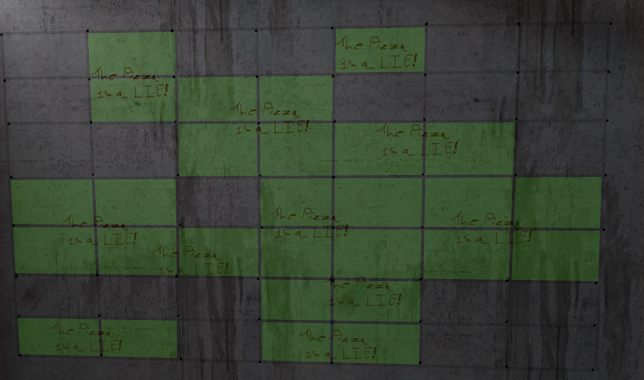
grid.png

I was thinking maybe it would be better to use the coordinates directly and plot them on a 2D coordinate system. For the pizza field, we would use the x and y coordinates, and for the wall of lies, the x and z coordinates. But then there’s the scaling and alignment issues, and maybe even an angular offset, to worry about. I don’t know, maybe there’s nothing to be found here, but the whole thing just seems too weird not to have any sort of significance or meaning.

The wall is made up of the materials/concrete/c1a4_silo4a_01.vtf texture. Unfortunately, it’s not only used here, but also in bm_c1a4c (Blast Pit) and bm_c2a4a (Residue Processing). The texture file is identical to the one in the mod release.

The Grid is 7 x 7 making a total of 49 boxes, the Number of highlighted boxes = 28, number of boxes un-highlighted = 21. All numbers can be divided by 7.

Remember the XOR suggestion and the “X” on the lies image? What about this: DES-X? Involves 64-bit XOR before and after. The hex code is divisible by a 64-bit block size.

Anyone remember the “note Welsh” hint? Check this out! Note the author! :thumbup:

It was also designed to be immune to brute force attacks–referring back to the “CIA couldn’t brute force it” hint.

Furthermore, DES was derived from the Lucifer cipher, which refers back to the “building a cage for Satan” and Dante’s Inferno quotes, as well as the lies image with the devil horns.

This might be our answer guys.

EDIT: Is anyone capable of composing a tool we could use to do this? Checking it by hand would take some serious time.

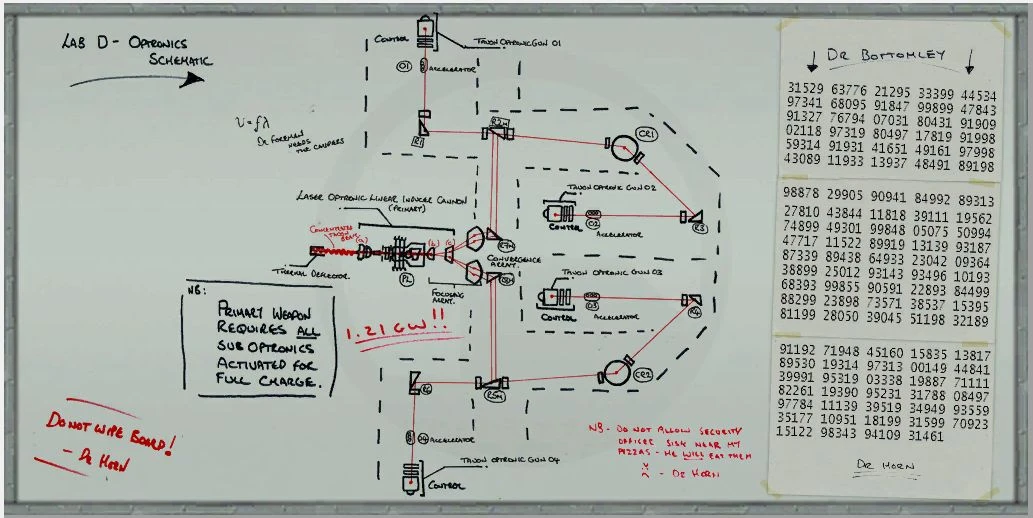
EDIT2: As for the key, we could use a 8-letter ASCII word that is pared to 56 bits (Benaloh(+) or Paillier, perhaps?) plus two 8-letter or -word addendum keys (10010851 and 39140914?)

One more thing! if you divide the hex code by a 64-bit block size, you get 47–another reference to previous thoughts on the ARG. It all lines up!

EDIT 3: Found a great XOR tool and description of how to use it if anyone is interested: Converter (download link is at bottom of page–choose the “Converter” option [2nd one down]). Basically, you input an 8-byte/digit/letter key, XOR it, run it through DES with a 7-byte key, then XOR it again with another 8-byte/digit/letter key (I use CrypTool 2.0 for the DES portion). I haven’t found a solution yet using BENALOH or PAILLIER/PAILIER as the DES key and 10010851/39140914 as the K1 and K2 XOR keys, but it might be wise for someone to run them all the same–never hurts to have another person do the same work in case of error. I know it’s a lot to ask for, but I hope we can get another tip from Storm at some point–all the pieces seem to point to this, but we still have the problem of uncovering what composes the key(s)–excruciatingly frustrating. I think we’ve earned it after 2 1/2 years of struggling!

Until then, we can keep trying keys. With the tools I mentioned, someone will eventually crack this if the method turns out to be correct!

This is some great stuff, I feel we might be making real progress here. I’m as dumb as a brick though, how will I be able to work out if something is 8 bytes long?

Generally speaking, 8 bytes is 8 characters/digits. In DES, those 8 bytes are parsed into 7 (64 bits into 56 bits), which simply means that it uses an 8-byte/character/digit key, but only 7 bytes of it are used. Therefore, a 7-digit/character word or number could be used and blocked out by a spare digit or character.

Right ok

In simple terms, as @Gunsrequiem said: 8 bytes can represent 8 letters, numbers, symbols or any combination of those. Example:

“paillier”
“12345678”
“L0!!yp0P”

In less simple terms, in case you’re truly interested…

Obviously, it’s not always that simple. Here’s a converter tool - enter any of the above in the box marked “ASCII”, and hit “convert”, and you’ll see that the rest isn’t always 8 numbers / letters long. It’s still all the same 8 bytes, though.

The problem is that we don’t always know what is or isn’t 8 bytes long. Especially since even a byte can mean different amounts of bits, rather than the “standard” 8 bits = 1 byte. Before standardization, 7 bits and 6 bits have also been used, for example. Something that is 8 bytes one way, may be something entirely different another way. (Sure, I know the encryption algorithms we have discussed use 8 bit-bytes… but that’s what conversion is for.)

In other words, I’d suggest: rather than looking for “8 bytes”, look for interesting phrases. Things that stand out, things that repeatedly show up, things that you don’t expect. And you don’t need to be smart to do so. A 5 year old can tell you if you’re doing something wrong or weird.

In other news… the problem we’re truly struggling with, in my opinion, is that we’ve got too much rather than too little, but all of it is horribly organized. Look at the wiki - it’s been a month since the steam release. Tons of new information has been found.

NONE of it is on the wiki.

A list of possible keywords has been suggested many times. I’m currently too busy with my masters thesis to actually parse through all the data we’ve got in these 180 thread pages, the wiki, and the various ARG-related websites. Please don’t make me do this? ;_;

Thanks for the detailed explanation, and I agree the wiki is a bit of a mess. I to am stuck with school work at the moment though, so I really can’t get into much editing right now. Maybe a new checklist on the wiki would help

I’m happy to do it! I need to update the timeline anyway. I’ll start doing it on paper over the next few days in my free time at work and update the pages respectively.

Damn! You’re Good!!!

Thank you, sir!

To assist with the list of possible keys for the wiki, I have created a possible key submission form on the blog: Submit a Possible Key

This will allow you to submit one or more keys and provide a brief description as to how you devised the key (if it is not inherently obvious). For instance, I submitted “greed” and “gluttony”, as they may be related to the Lies.jpg image on which Storm wrote: “Steals it. Eats it.” At this point, I’m not going to stress too much over how many characters are allowed (although we should be shooting for under 40 characters, I’d say)–if it starts to get ridiculous, however, I’ll have to alter/limit the form submissions in some way. I think we’re all adults here, however, so I’m pretty sure you guys and gals can handle the intense responsibility!

Every visitor has the option to view previous submissions, and I will ensure that I update the wiki with a page to reflect said submissions–one that will be updated occasionally (as time permits). My plans for the wiki, as of now, include two new pages (“Possible Keys” and “Steam-Release Discoveries”) as well as an addition to the “Timeline” page. I expect these to be up and fleshed out within the next couple of weeks. If you have anything you’d like me to include, please message me here or utilize the Submissions page on the blog. Thanks!

About that…

Steals it.
Eats it.

Storm, how do you not go crazy reading this forum? You must shake your head 18 times every time you visit. I don’t think I could have held the beans in this long, personally.

hey the we got hostiles pizza is a lie is missing but the biodome logo still exists just a heads up

He’s probably laughing at us right now.

hey the we got hostiles pizza is a lie is missing but the biodome logo still exists just a heads up

You’ve said

yeah whoops somehow when my internet went out it sent a duplicate post

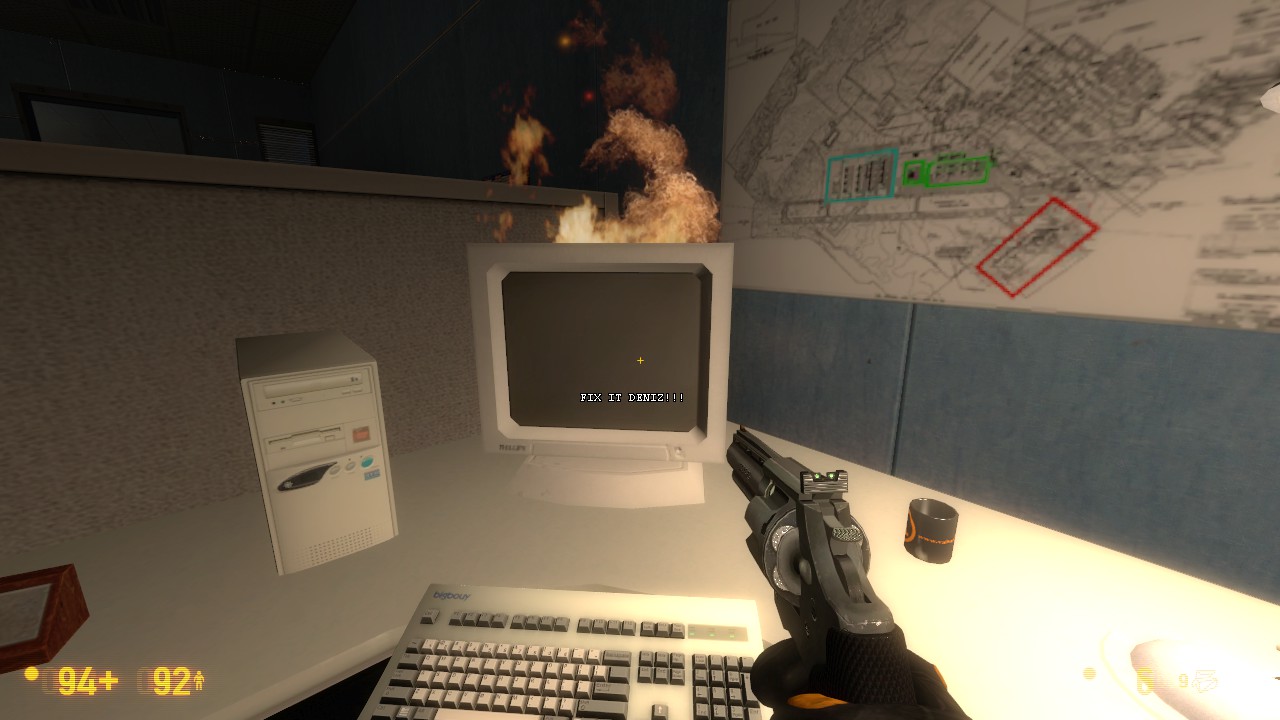
OK, so I found the same screen on the computer monitor on Dr D. Sezen’s desk in the Biodome Administration office, where it makes much more sense. Dr D. Sezen is the in-game alias for Deniz Sezen (known as @your-name-here on the forums) who is the lead programmer.

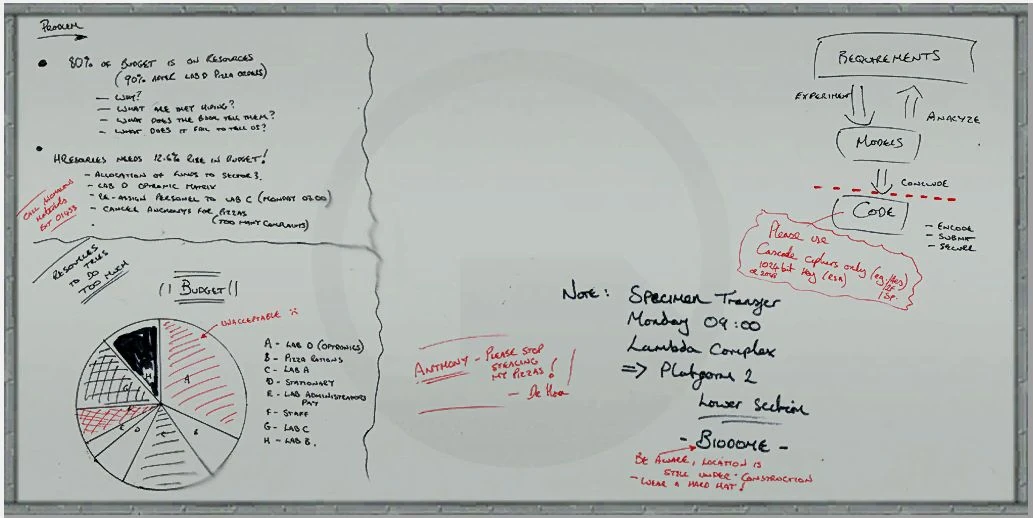
This means that the “board over yonder” most likely means the “pizza budget” whiteboard, which is also found in that office. Interestingly, that’s also the whiteboard that has the word “Code” written on it.

And, as @Jake12344 noted, if you try to use the keyboard, this happens:

Founded in 2004, Leakfree.org became one of the first online communities dedicated to Valve’s Source engine development. It is more famously known for the formation of Black Mesa: Source under the 'Leakfree Modification Team' handle in September 2004.