
Kind of sad that’s really just the best solution to all of this.
Photoshop CS2 and in fact the entire Adobe Creative Suite 2 are up for download with serials over at https://helpx.adobe.com/creative-suite/kb/cs2-product-downloads.html# You’ll need an Adobe ID to access them on that page, though you may find trusted third-party mirrors that do not require it. Even though nobody is going to care about this, please be advised that the software is technically not free to use, these downloads are officially just to help out customers who have bought CS2 and cannot access their activation servers. However, no statement has been issued by Adobe not to use these downloads for personal use without having purchased the Creative Suite 2. You have been warned and act under your own responsibility.
Gunsrequiem, could you tell me what you exactly meant in this post, just curious.
Just that the ARG has made me cuckoo for Cocoa Puffs.
WARNING: Info dump ahead.
From the JS-Files on stormseeker’s site:
In the X-Files TV series, “Trust no one” were the last words uttered by Deep Throat before dying in the episode 1x24 “The Erlenmeyer Flask”. The episode contained the tagline “Trust No One” in the opening credits, while all the previous (and most of the following) episodes contained the tagline “The Truth Is Out There”.
In the X-Files movie (X-Files: Fight the Future), the Well-Manicured Man says “Trust no one, Mr Mulder” after blowing the head off of the driver who is assigned to kill him if he doesn’t go through with the plan to kill Mulder.
In the episode 2x01 “Little Green Men”, agent Scully is at Mulder’s apartment trying to find some trace of where he has gone. She tries to gain access to his computer and fails twice with password guesses. The third time she succeeds as she figures out that his password is “TRUSTNO1”.
“Trust No 1” is also the title of episode 9x06. The tagline of the episode was “They’re Watching”…
twenty1into1… trustno1…
I know that we have found this, but has anyone seen this before? It seems so new. It also seems so different than the other .js file.
Never seen that .js file myself before, but I am still new here.
I took a look at the images in the second JS file. I couldn’t find anything in the image files linked. I think error404 is a red herring account run by the developers.
I saved a copy of the /js directory index and all the JS files back when it was first reported on the forums, and nothing has changed from what I can see.
The JS files are used for preloading the gallery images on the various pages of stormseeker’s portfolio site. They are identical except for the images. For example, plqe.js is used by the Questionable Ethics portfolio page.
EDIT: I should mention that, at the time when the JS files were discovered, the front page of Storm’s site was still the same old “Coming Soon…ish” page, IIRC. The new portfolio site went live some time after the Steam release.
Or he could be trolling us, but it is hard to tell here, although he has spread some useful information.
Edit: I forgot to mention i found this image on the 404 site.
[attach=4222,none,859][/attach]
It is Probably not related, however i am not entirely sure about that.
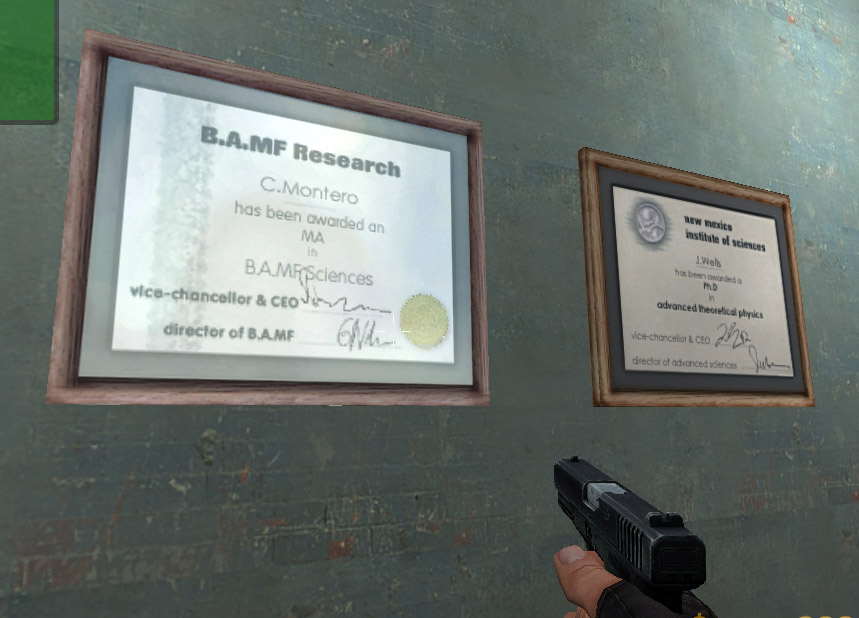
@Nonimportantuser B.A.MF = “Badass Motherfucker” I think. But still, nice catch! Never noticed it before haha.
Yea, i had a feeling it was another joke. The page has a lot of them. In speaking of jokes here is another one i found.
[attach=4223,none,1024][/attach]

They’re WAITING for you Gordon… …in the groove chamber.
That is strange . . . perhaps a fluke? Either it’s that, we got Rick Rolled, or the use of it for advertisement of the game is no longer necessary. As for the state of the ARG, I’m of the belief that we need a very (obvious) targeted clue to keep this thing going, or some sort of paring down of the information we’ve already been given. There are so many different directions to this thing that not having a way to weave the threads is going to consistently put us on our asses. The bruteforcing of possible keywords clearly did not work–so, if that is the answer, we simply need a way to decipher the clues that is a bit clearer. That’s not to say he just give it away, but even those gents at Cambridge don’t have a chance with the information scattered the way it is.
EDIT: Also, just some things to keep in mind–remember how Storm said we should focus on the story? I’ve highlighted the areas that I think are most important for us to focus on, especially the part about elements of the game “warning” players away from them. There are red herrings, and then there are watchdogs . . . .
ARGs are sometimes described as the first narrative art form native to the internet, because their storytelling relies on the two main activities conducted there: searching for information, and sharing information.
- Storytelling as archaeology. Instead of presenting a chronologically unified, coherent narrative, designers scatter pieces of the story across the Internet and other media, allowing players to reassemble it, supply connective tissue and determine what it means.
- Platformless narrative. Stories are not bound to a single medium, but exist independently and use whatever media is available to make itself heard.
- Designing for a hive mind. While it might be possible to follow games individually, designs are directed at a collective of players that share information and solutions almost instantly, and incorporate individuals possessing almost every conceivable area of expertise. While games might initially attract a small group of participants, as the participants come across new challenges they try to find others with the knowledge needed to overcome an obstacle.
- A whisper is sometimes louder than a shout. Rather than openly promoting games and trying to attract participation by “pushing” it toward potential players, designers attempt to “pull” players to the story by engaging in over-the-top secrecy, have elements of the game “warn” players away from them, and eschew traditional marketing channels. Designers do not communicate about the game with players or press while it is in play.
- The “this is not a game” (TINAG) aesthetic. ARGs themselves do not acknowledge that they are games. They do not have an acknowledged ruleset for players; as in real-life, they determine the “rules” either through trial and error or by setting their own boundaries. Narratives present a fully realized world: any phone number or email address mentioned works, and any website acknowledged exists. Games take place in real time and are not replayable. Characters function like real people, not game pieces, respond authentically, and are controlled by real people, not by computer AI. Some events involve meetings or live phone calls between players and actors.
- Real life as a medium. Games use players’ lives as a platform. Players are not required to build a character or role-play being someone other than themselves. They might unexpectedly overcome a challenge for the community simply because of the real-life knowledge and background they possessed. Participants are constantly on the lookout for clues embedded in everyday life.
- Collaborative storytelling. While the puppetmasters control most of the story, they incorporate player content and respond to players’ actions, analysis and speculation by adapting the narrative and intentionally leave “white space” for the players to fill in.
- Not a hoax. While the TINAG aesthetic might seem on the surface to be an attempt to make something indistinguishable from real life, there are both subtle and overt metacommunications in place to reveal a game’s framework and most of its boundaries.
It’s probably just an oversight. It’s happened at least once before.
EDIT: Regarding the story: Is it just me, or has it occurred to anyone else that the new references to Dr Horn, found in the Steam release, seem to be more about Dr Horn - the level designer, than Dr Horn - the quantum optronics scientist?
Looking back on the thread i have seen a few times when other users reported the domain expiring at least one or two times.
It certainly is very strange indeed. Although I have only been here for a little over a month, i have looked back on this thread and have noticed that this has happened at least once like Nonimportantuser and flavrans9 mentioned, however I still need a few questions answered. Maybe this is something new that’s related. No one has looked at the pages current elements, right? Other suspect pages? This whole arg at times to me at least, seems nearly unsolvable. Who has been confirmed to be in on this arg as I would like to know? How many confirmed websites have possible important information to the arg? Other than that I need Some tools so could someone compilE a list of thEm for Me.
Edit: sorry for bad grammar, as my grammar.exe has crashed.
Anyone notice that error404notfounds post are a little weird?
The capital letters in error404notfound’s post:
[tt]I A I N I M N O T W I H O I S E E M[/tt]
“I’m not who I seem” ?