Kxbm.net is down, portions of blackmesasource.com are down… odd timing yes?
also, crowbarcollective.com is down???

Kxbm.net is down, portions of blackmesasource.com are down… odd timing yes?
also, crowbarcollective.com is down???
It’s probably just the domains expiring again…
From what I can gather, the server hosting both kxbm.net and terminal.blackmesasource.com has been moved to a new hosting provider, and as a result now resides at a new IP address. The reason kxbm.net and terminal.blackmesasource.com appear to be down (even though the sites are in fact up and running on said server), is because most of the BM sites are fronted by Cloudflare, and apparently Cloudflare doesn’t know that kxbm.net and terminal.blackmesasource.com have moved to a new IP address.
In the case of crowbarcollective.com, the site is currently redirecting to a page saying that the account has been suspended. Maybe they are in the process of moving that site as well, or maybe someone forgot to pay their hosting bill.
check this out.
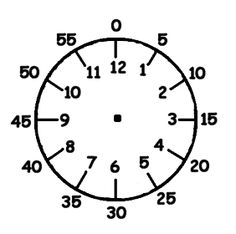
21 goes into 1, time reveals all. the clock that shows 21 into 1 is set to the time.
10:12
so the ticks on the clock ever 5 min starting at the 10, equals the 50th minute. 11 is the 55th, etc.
so if we count each minute as an individual number. we get this.
5 10 15 20…
10…11…12…1…2… the “dots” equal 1 2 3 4 so 10 1234 11 1234 12 1234 1 1234 2 12
10123411123412123411234212=
abcdefghijklmnopqrstuvwxyz
we get 26. the length of the alphabet.
a1b2c3d4e5f6g7h8i9j10k11l12m13n14o15p16q17r18s19t20u21v22w23x24y25z26
1234567891011121314151617181920212223242526
50 51 52 53 54 55 56 57 58 59 12 1 2 3 4 5 6 7 8 9 10 11 12
10-----------------------------------------------------------------------------12=26 we have our alphabet? if this is the case, we should be able to assign values to 0-9 a-f???
On UK keyboards, the “¬” symbol is where the “~” (tilde) symbol is on US keyboards, which means the symbol was literally just a keystroke away for Storm. It’s not like he would have had to look the symbol up from a table or anything like that.
That being said, the use of the symbol is interesting. In the IRC clues, it always appears next to a “|” (vertical bar) symbol. There’s some kind of historical connection between the “|” and the “¬” symbol. The ASCII code point value for “|” is 124, or 7C (hex). But before 1965, code 124 was the control code for ACK. Between 1965 and 1967, it was used for the logical NOT symbol “¬”. And then from 1967 onwards it was used for the “|” symbol. The “¬” symbol is now found at code point 172, or AC (hex).
The problem is that Storm specifically said that it couldn’t be brute forced, and he said this not long after Matherunner described a “viable” DES brute force attack against the 752 hex code. But what if it’s not about brute forcing the solution, but rather doing something that will take a long time to finish? Just look at all the quotes that have to do with time:
What if solving this takes a long time, even if you know exactly how to solve it? If it’s not brute forcing, then what could it be? An incredibly long cascade of encryptions using the same cipher and key? What if we need to run decryptions for days before the solution can be found?
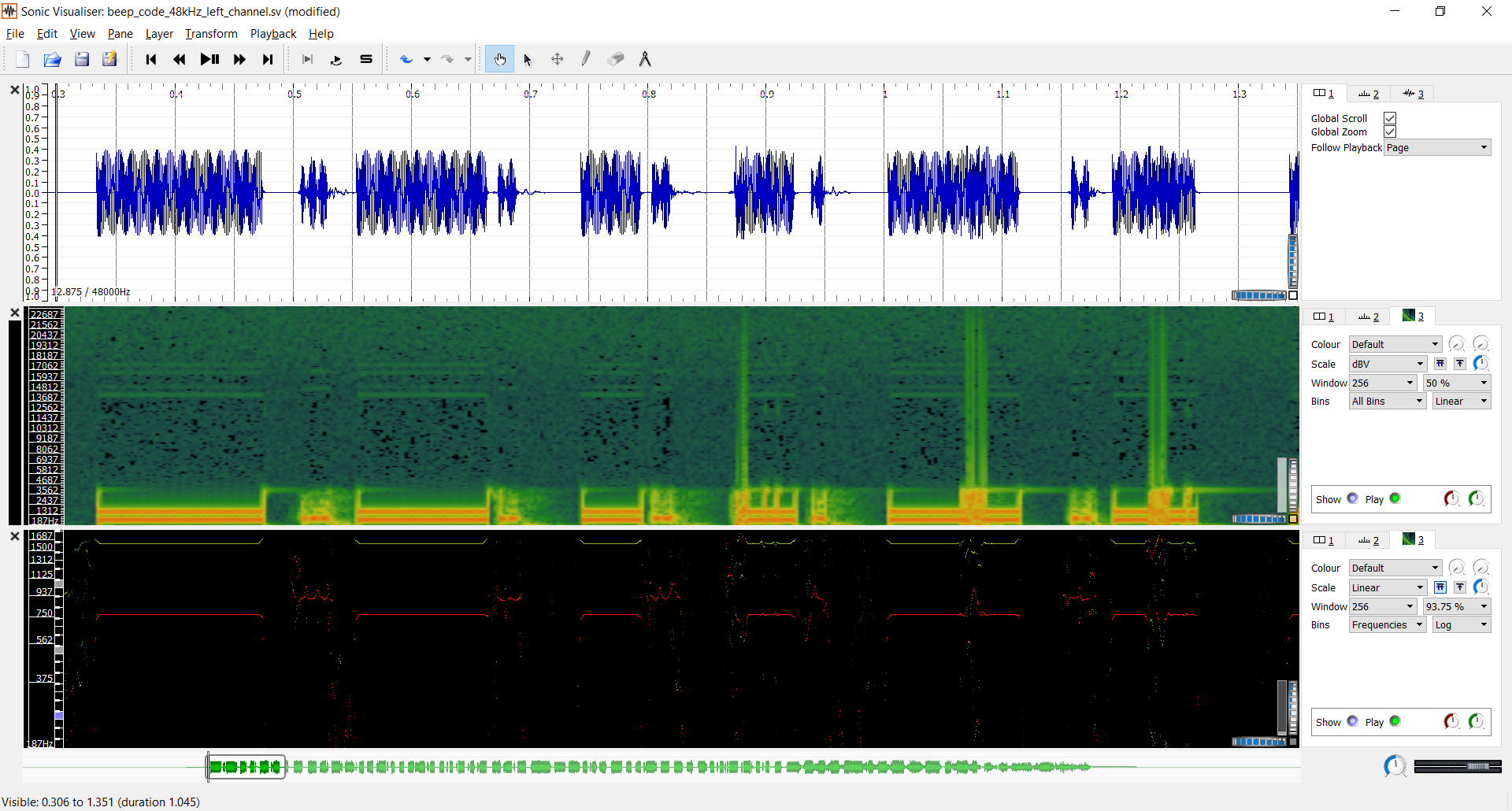
The bmrf.us answering machine beep (code?) sequence is still bothering me at the back of my mind. I’ve been too busy to do anything more with it. I’m almost certain that it was not made by a human tapping away on a key. The duration of the pauses between the beeps were too accurate and constant. It must have been generated programmatically. Why would they do that if it’s just fluff? It could of course just be some stock sound they used to make things interesting. But if it really is a code meant for us to solve, then we suck at this so badly that we can’t even solve anything new they throw at us.
Yeah, there’s definitely something odd about those beeps. I’ve tried slowing them down and analyzing them, but nothing stuck out in terms of hidden voices or whatnot. That doesn’t mean the beeps themselves aren’t a message, however.
Have you tried looking at the timings of each beep? Maybe it’s supposed to be some sort of timing-related alphabet.
Like Chuck “Morris” Code? 8o
I’ve made another pass at measuring the timings of each beep. My initial measurements were inaccurate and incomplete. I now believe that the timings are supposed to be in 100ths of a second. Therefore, every timing value has been rounded off to a 100th of a second.
These are the durations (in seconds) of each beep in the sequence:
[spoiler]
0.14
0.11
0.05
0.05
0.11
0.07
0.04
0.11
0.11
0.05
0.11
0.11
0.05
0.05
0.09
0.04
0.05
0.05
0.07
0.05
0.05
0.04
0.08
0.05
0.09
0.10
0.08
0.11
0.24
0.11
0.11
0.05
0.04
0.05
0.14
0.05
0.05
0.11
0.11
0.09
0.07
0.08
0.05
0.05
0.11
0.09
0.05
0.05
0.08
0.16
0.11
0.08
0.11
0.24
0.05
0.11
0.15
0.14
0.18
0.08
0.14
0.05
[/spoiler]
or in milliseconds if you prefer:
[spoiler]
140
110
50
50
110
70
40
110
110
50
110
110
50
50
90
40
50
50
70
50
50
40
80
50
90
100
80
110
240
110
110
50
40
50
140
50
50
110
110
90
70
80
50
50
110
90
50
50
80
160
110
80
110
240
50
110
150
140
180
80
140
50
[/spoiler]
Each beep is separated by a pause of 0.08 seconds (or 80 milliseconds). There are 62 beeps in total.
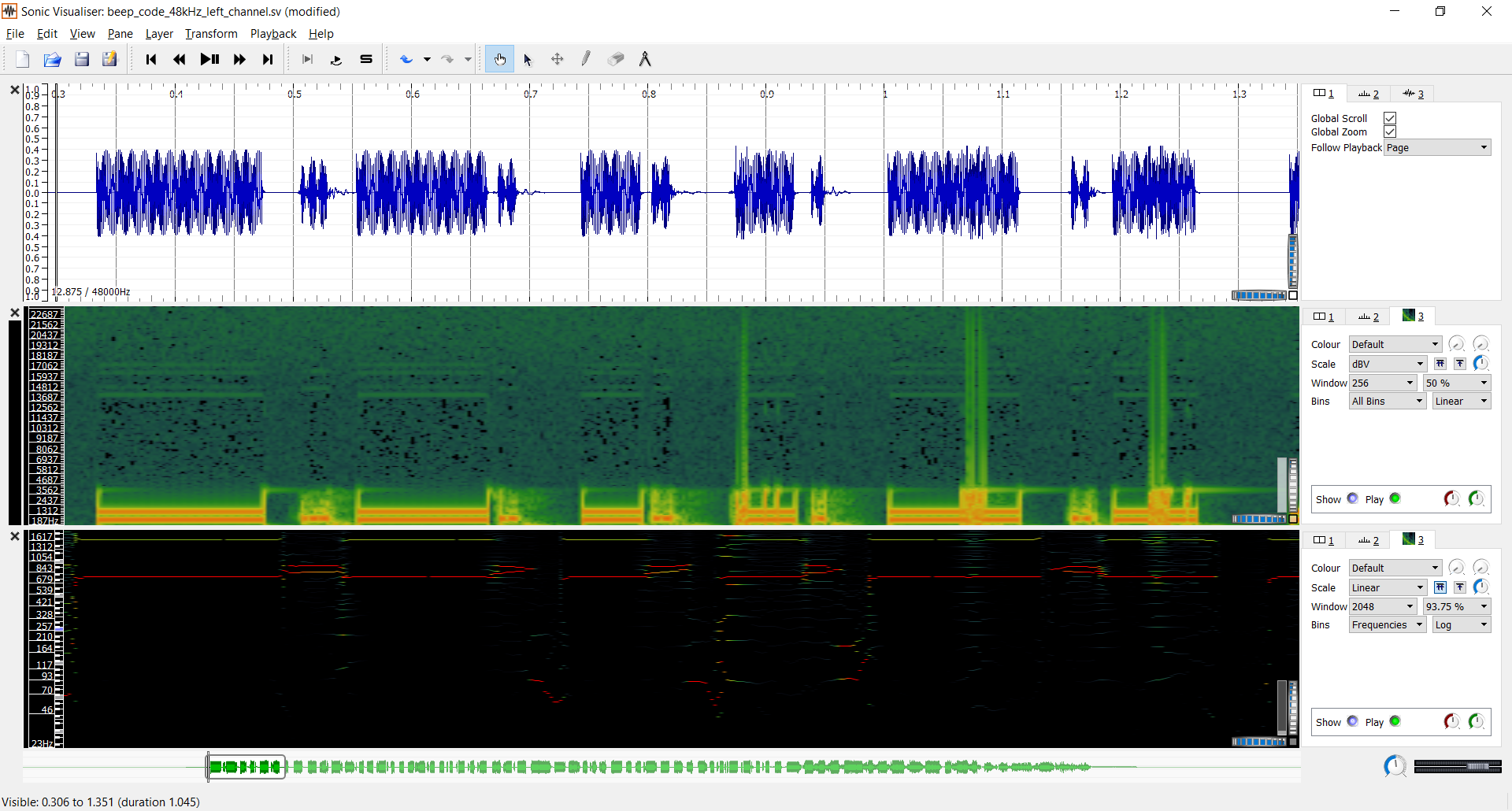
There is one problem, though. In many places in between the main beeps (within the 0.08 s pause), there are what seems to be short “rogue” beeps, or blips if you will, and I’m not sure what to make of them. I’ve simply ignored them as noise for now. While the main beeps are clearly defined as dual tone beeps with the frequencies 770 Hz and 1633 Hz, which correspond to the DTMF B key, the “rogue” beeps also seem to be dual tones, but have frequencies around 846 Hz and 958 Hz, which don’t correspond to a valid DTMF signal. And if you look at the second attached image, where I’ve increased the frequency resolution in the peak frequency spectrogram (at the expense of temporal resolution), you’ll see that these “rogue” beeps aren’t as clearly defined as the main beeps, frequency-wise.
The next step will be to analyze the timings themselves, but I’m out of time for today.
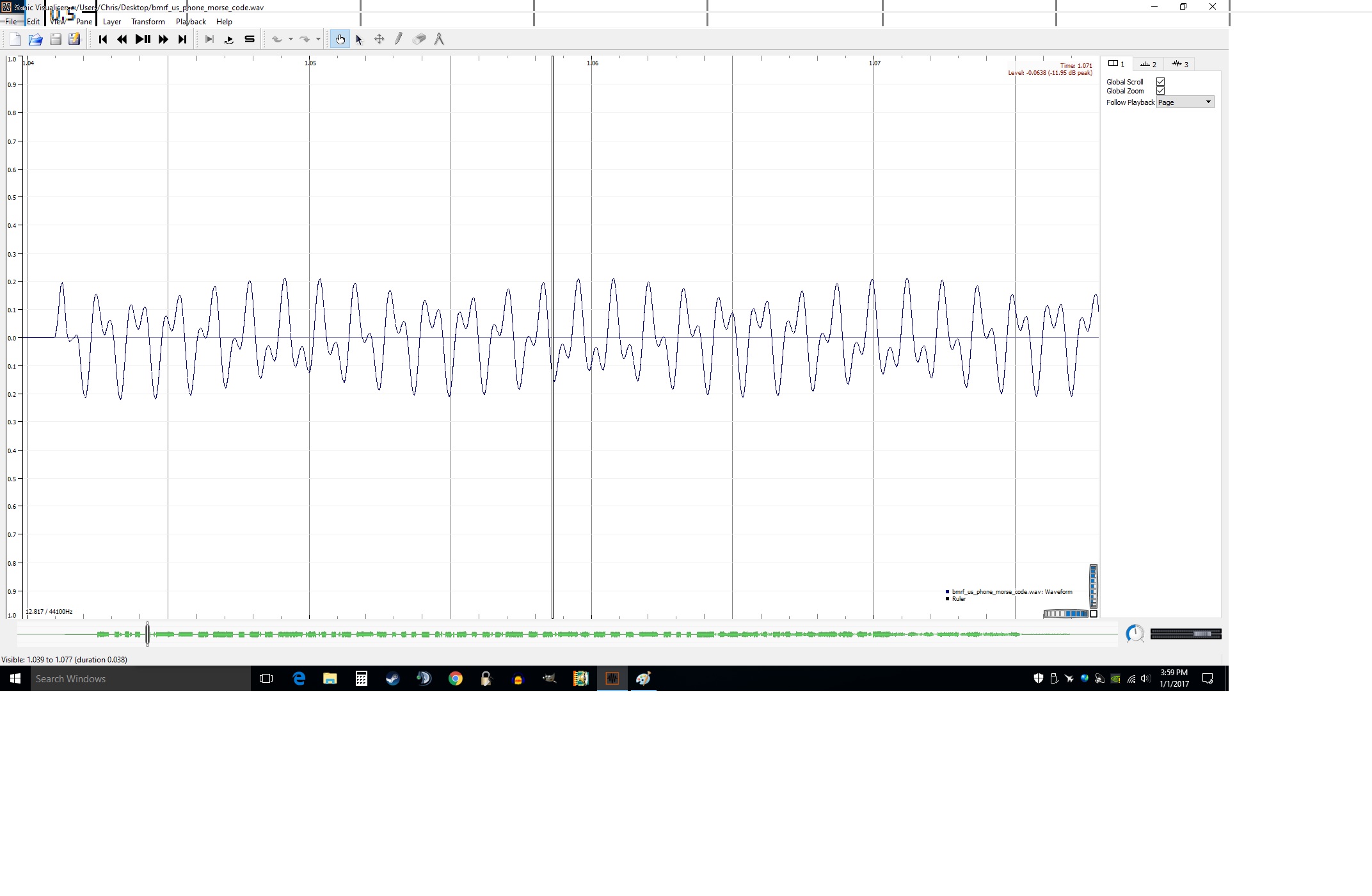
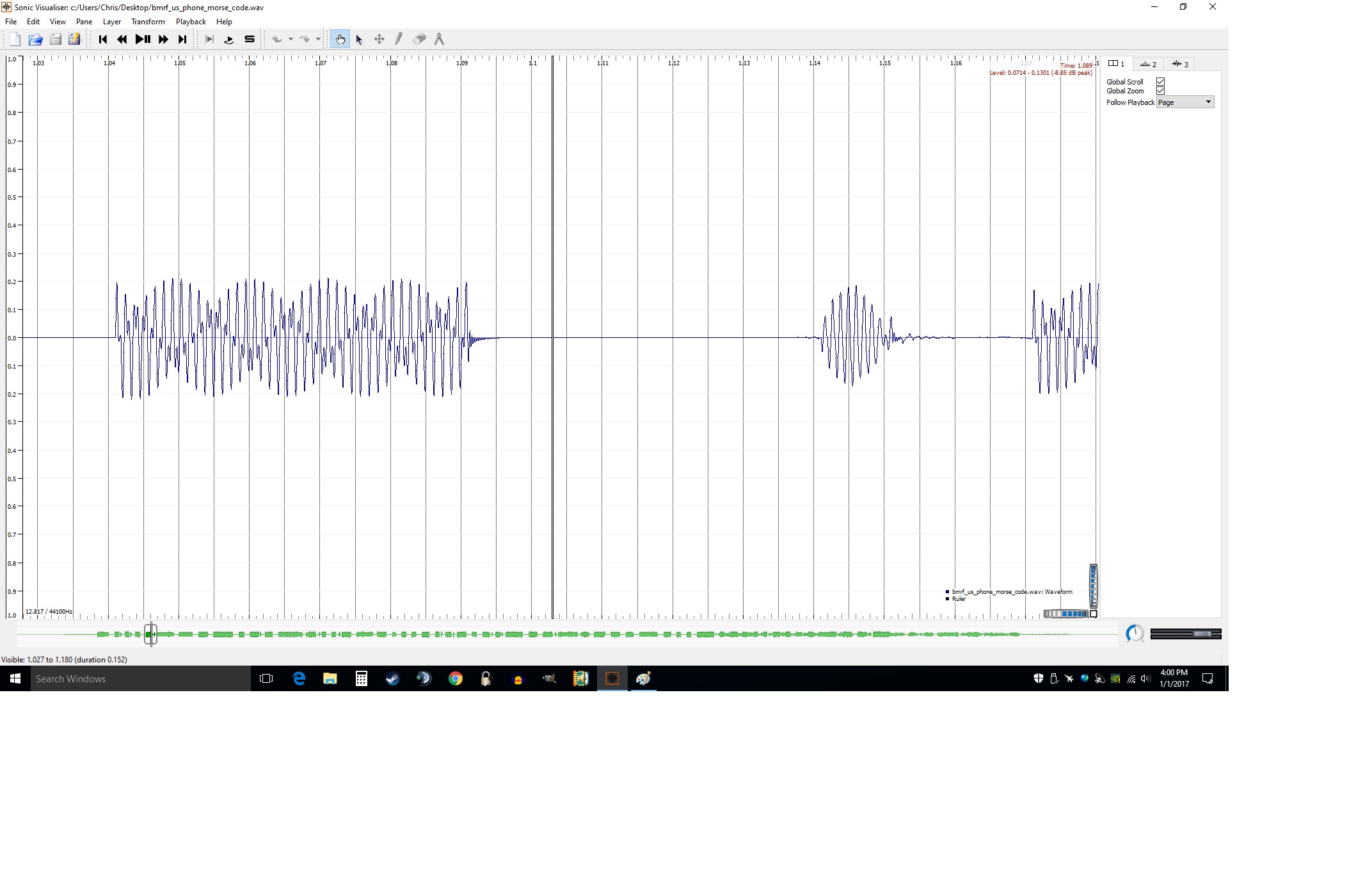
I took it a bit further. take a look at it like this. you can see there is a helix algorithm, the pizza code + helix. so I think this is pretty close to a template, ranges from 2-1-0-1-2 you can see that it is a HIGH LOW format, then it flips, and so on.
here is what it looks like at 2 close up resolutions. I don’t think its the length of the beeps, I think its whats embedded in them.
I made a template that is fairly close, someone I’m sure can fine tune it. but you can see what we need to do.
high 5!
youtu.be/MJAvW0RCx8w
I’m sorry, drgibbles, but what looks like a helix in your second image is just an interference pattern effect in the waveform display. It’s a result of the superposition of the two sine waves in the DTMF tone, which are at different frequencies, one at around 770 Hz and the other at around 1633 Hz.
yes, a pattern,
So, what exactly is the point of this? I’ve tracked this for a long time, but I’m just curious, what will this lead to? any ideas? usually these ARGS lead to an early release of a game like Portal 2, except BMS is already out, so, what else could happen? HL3? is Black Mesa Xen going to be an ARG to discover codes related to HL3?
Not every ARG leads to some sort of video game release and this one is not related to HL3.
Are you from their team? I’m new, btw.
Devs will be marked out by a “Developer” tag where other users have their post-count tags (Mine is Alien Grunt, yours is currently Cockroach, etc)
I can’t remember if Stormseeker (the main dev behind the ARG) has explicitly stated this anywhere, but since Valve wasn’t even in contact with the team until after the mod release and people started finding clues, I think it’s safe to say there isn’t any Valve project waiting at the end of this.
Welcome to the forums. 
Indeed. The ARG has nothing to do with Valve. It’s an entity of pure evil devised entirely from the sick, twisted mind of the one and only stormseeker!
The SETUN computer, was Russian made, and used a type of ternary, NEGATERNARY, which is pretty obscure, its negative base 3, or balanced ternary.
https://en.wikipedia.org/wiki/Setun
In Setun printings, −1 is represented as overturned 1: "1
there was also made ,
DSSP (Dialog System for Structured Programming) is a programming language designed for Setun.
DSSP’s structure stays very close to the actual machine. It uses reverse Polish notation, a stack-oriented form of calculation.
so we have inverse functions, upside down numbers, and reverse notation. the "these are some important numbers image. has numbers in trinary. then in the upper right corner, there is the 24/2/
that’s how negaternary is done as well, take a decimal number, divided by -3, then it continues to divide the sums by -3 and you read off the remainders from back to front and that gives you the negaternary. can anyone run this as a function and see what it gives?
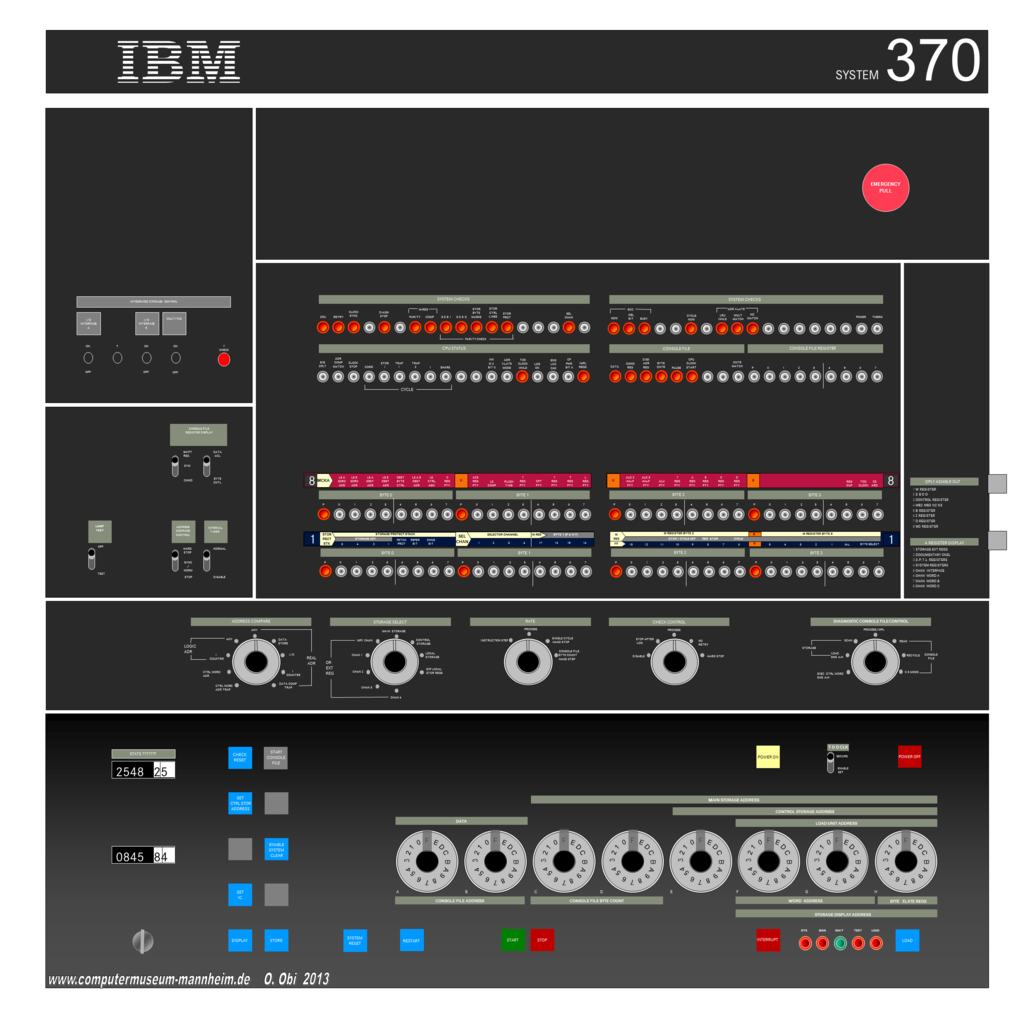
was looking up program status words for ibm, and stumbled onto this picture. just thought i’d share. even reading about the psw, I still don’t know what it even means, I did find a site that decodes it though and ill link that here as well.
https://www.longpelaexpertise.com/toolsCode.php
Founded in 2004, Leakfree.org became one of the first online communities dedicated to Valve’s Source engine development. It is more famously known for the formation of Black Mesa: Source under the 'Leakfree Modification Team' handle in September 2004.