
I was thinking it over again and notice how if you subtract both 2 from 6 and 2 from 9 what number do you get afterwords?
Just something I have made note of:

On this whiteboard, we see an extension: “1187.463”
We also see mention of niobium 5. Now, referring back to the Tempus page, we don’t have a direct niobium 5 isotope, but we do have an isotope that has a nuclear spin of 5+:
98mNb 84(4) keV 51.3(4) min β- (99.9%) 98Mo (5+) IT (.1%) 98Nb
Here is also a reference that has the same data: Niobium.pdf
Now, aside from the IRC clues, this is the most direct reference to HALOS that we have. That said, it’s likely that the extension mentioned on the board is very important (a website prefix or suffix, perhaps?), or that the resulting data from the list of isotopes is somehow important, too.
Any thoughts on this?
EDIT: Another thing, and I can’t believe I didn’t notice this before: This whiteboard references Paul Bottomley, which was only done once before, and that was on the direly important Code D whiteboard. Therefore, I think it goes without saying that this whiteboard is extremely important to solving this stage of the ARG.
Could the 1187.463 be an x, y or z coordinate for a position in a map/level? Are there any x’s, y’s, or z’s on the board or anything that might denote which one/if it is?
That is an excellent idea! In fact, we have other whiteboards with extensions on them. Let me find the rest, and I’ll post them here.
EDIT: This also makes sense because we have other coordinates and location data provided in the IRC clues.
Here is the whiteboards page on the wiki: Whiteboards
Here are the ones that have extensions on them, purportedly written by Dr. Horn (links included rather than images to save forum space):
The aforementioned whiteboard: https://thepizzaisalie.wikia.com/wiki/Whiteboards?file=C0a1x_labboard_am1.jpg
One that mentions the biodome (also noted as important): https://thepizzaisalie.wikia.com/wiki/Whiteboards?file=C0a1x_labboard_am4.jpg
Another one referencing the biodome: https://thepizzaisalie.wikia.com/wiki/Whiteboards?file=C0a1x_labboard_am6.jpg
Board with cascade ciphers mentioned: https://thepizzaisalie.wikia.com/wiki/Whiteboards?file=C2a4x_labboard15.jpg
These are the four that I found, but it’s possible I missed one or two. I seriously can’t believe we didn’t examine these closer before. They are so obviously important!
Hello! I zoomed (Z btn) a screen in chapter Questionable Ethics (map bm_c2a4e). There is BATCH file that has commentary about Dr. Horn. Sorry if someone has already found it.
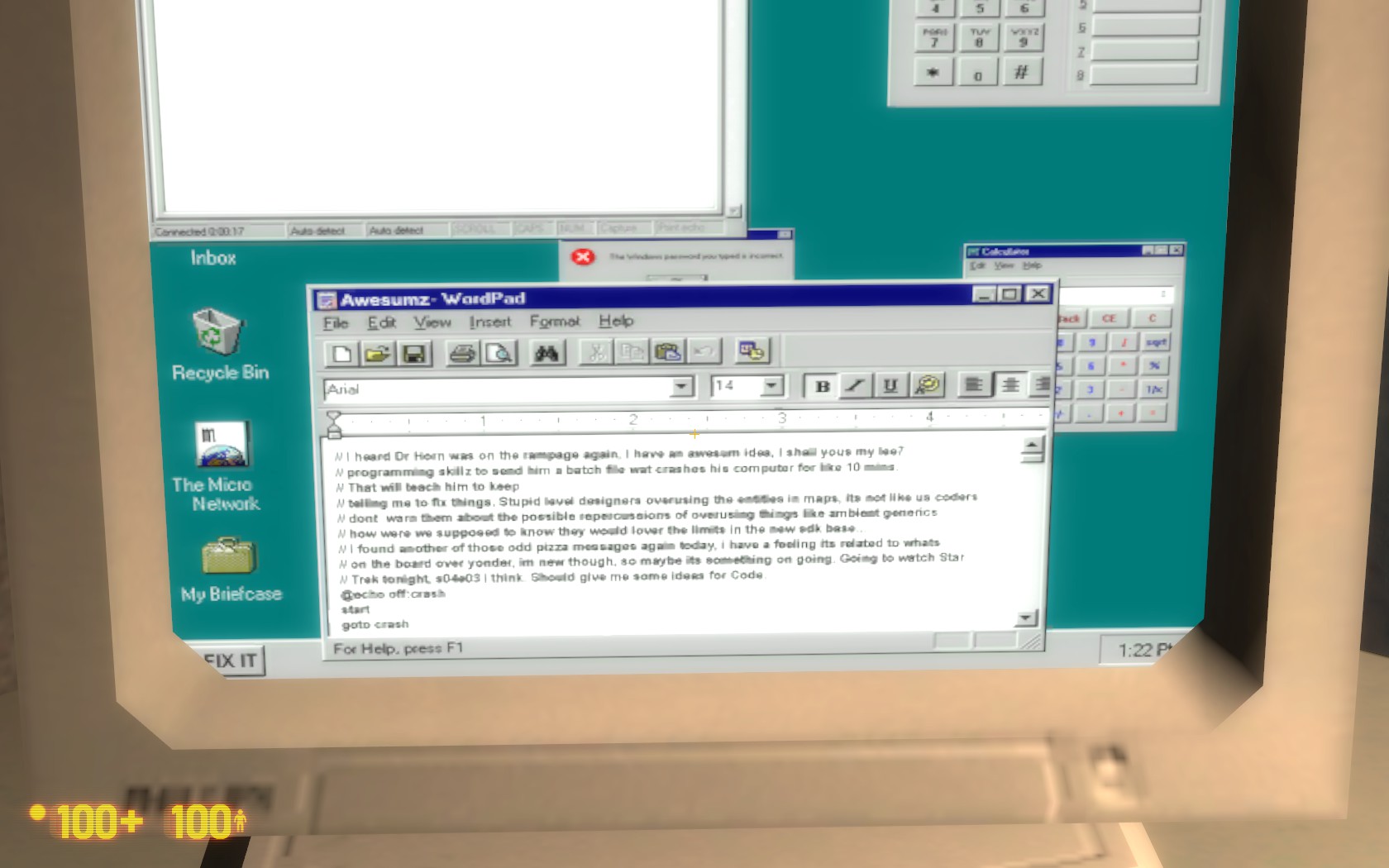


You know, the strangest thing is that 1187 is also the name of another Source mod. That’s what I thought of when you first gave that number.
Just so it has its own post as a reference, here are the four whiteboards with extensions:
The aforementioned whiteboard: thepizzaisalie.wikia.com/wiki/…le=C0a1x_labboard_am1.jpg
One that mentions the biodome (also noted as important): thepizzaisalie.wikia.com/wiki/…le=C0a1x_labboard_am4.jpg
Another one referencing the biodome: thepizzaisalie.wikia.com/wiki/…le=C0a1x_labboard_am6.jpg
Board with cascade ciphers mentioned: thepizzaisalie.wikia.com/wiki/…file=C2a4x_labboard15.jpg
And here are the associated extensions:
1187.463 - (Niobium 5 board)
384 - (Biodome 1 board)
186759 - (Biodome 2 board)
01633 or 01433 - (Cascade ciphers board)
Can anyone tell definitively what that last one is? Maybe with the updated textures in the Steam version of the game? It looks like Storm’s 4’s, but the loopy part is low enough to be a 6.
I can’t believe we’ve been so blind to this! Any thoughts as to what it could be? Maybe we are supposed to convert it to hexadecimal and addend it to the HALOS.txt file?
EDIT: It just so happens that the number of digits is 21
I think it’s safe to say, then, that this is likely our key. We still have the issue of determining which cipher, but at least now we have the 21 digits that can be arranged to make our key, which should make the process a lot easier. These are in order based on the number of the map, but it’s possible they need to be rearranged in some meaningful way.
EDIT 2: Some ideas on how to go about arranging them:
They have 7, 3, 6 and 5 digits, respectively, so we could try in ascending or descending order, or by arranging them in some meaningful way based on how many digits they have within them.
Why are the white board extensions suddenly big news? They’ve had a wiki article since the beginning of time.
Perhaps, but I don’t think it was proposed that they are in and of themselves a potential key. Having a page with copy-pasted data doesn’t mean there’s an inference behind it.
True, and so too is the rest of the whiteboard (a couple minutes after that scene with the prison cell, they begin discussing the niobium 5 needed for the AI project). However, I don’t think this should exclude the possibility that the extensions are important or could be used as a key. In fact, this may further implicate that they are important to the ARG, particularly if Storm is a fan of the show and wants to reference it in his masterpiece.
You guys do realize, this is the first time we have gained plausible headway in roughly 2 years? We should be reveling in our possible discoveries.
Very true–I think this might really be something, and I’m not saying that simply because I put it together; the 21 digits confirmed the validity of it for me. Now we just need to figure out how to use it.
EDIT:
Just a rudimentary examination here, but if you convert 118746338418675901633 to hexadecimal, you get 66fefbda58f7f8000.
If we are looking at padding out the HALOS.txt file, adding the 66fefbda58f7f800 to the end of the 752-character hexadecimal bit (leaving off the last 0, as it doesn’t compose a full byte) you end up with 768 characters, 384 bytes, and 3072 bits.
3072 bits gives us a possible block size of 128-bits (24 blocks) or 192-bits (16 blocks), as well as still keeping 64-bit block sizes as an option (48 blocks). In essence, I think the use of “extension” could mean we are literally meant to extend the HALOS block size.
This doesn’t mean we have to pad out the hex code, but it opens some new doors.
I said this months ago, i sat and watched every episode of bugs for clues, and came across the conclusion that they used this idea as a base for this ARG.
Also wasnt there a quote saying “this unlocks at the start of the end” somewhere on the Wiki? Maybe its intended to be placed at the Start of the Halos Code, which unlocks the end of the ARG.
My only hope is that we will get some sort of confirmation from Storm regarding this, especially considering the lack of progress for the past 2+ years. I know it’s not always in the best interest of the ARG creator to give out information, but considering we would still need to figure out the mode/method, I don’t think it would be too much for him to at least confirm that this 21-digit number is involved. I suppose we shall see, however. Until then, I’ll continue to enjoy my time with BM!
My suggestion would be to check the different combinations are prime, since, according to one of JohnNotjohn’s old posts, the Halos file requires a very large prime number as it’s password. This could be it.
Well, if you believe the combination of those 4 numbers is really the key, here’s my thoughts:
- If we’re basing this all on “21 into 1”, I think we would need to merge them somehow (“into 1”, not “used at the same time” or w/e).
- Not counting inverting, shuffling or otherwise manipulating the individual numbers, there’s 24 possible permutations. That’s doable. Even if we’re unsure about the last one (I believe it’s a 4, not a 6, btw) it’s still only 48 options to check.
- If you do not count the . in the first number, which is what we’re doing to come to the conclusion of a total number of 21 digits, then we’re only 3 short of 24. With a byte for each, that’s 192 bits, a valid length for an AES key. As discussed months ago, AES is the most likely encryption method to have been used (it was heavily hinted at in Horn’s PM, years ago). Seeing as there are 4 numbers, simply adding a space, dot or dash in between the numbers would get us exactly there. A dot being the most likely in my opinion, as it is the only non-numeric character in the numbers found (1187 . 463).
- Still not sure what use Benaloh Paillier has in this situation… but perhaps it’s part of the next phase. I do rather doubt we’re supposed to actually use the algorithms they probably reference. I don’t think there’s any easily available implementations out there (for at least one of the two), and having us implement the benaloh and/or paillier algorithm ourselves is a weird step to take for an ARG of this size. Especially as it means Horn (or someone near him) would have had to implement it themselves in order to encode it in the first place. One tiny mistake on either side and the results are way off. Not saying it’s impossible or unthinkable, just… a very risky strat to go with, and one I would not have taken in stormseeker’s position. I mean, if this really is the answer to “21 into 1” and THAT took us 2 years, can you imagine the result of going with requiring a homemade implementation of an encryption algorithm?
The other thing to ask ourselves is “1 what?” One key, one iteration, one solution?
There’s still the problem of blocksize though, The current hex code is 3008 bits long, which is not divisible by 128,192,or 256. Code hinted at the hex code having to be encoded first, to fit a block size of AES. We should figure what encoding to use, and if it is well known or some obscure one.
As I noted before, I think it’s likely that it needs to be prefixed or suffixed utilizing the hex bytes pulled from the 21-digit number generated by the extensions off the whiteboards. If we use only the full bytes, dropping the last “0”, we come up with 3072 bytes:
I didn’t note it in that post, but 3072 is also divisible by 256 (12 blocks).