[ARG] The Pizza Code Mystery

Dammit, I went to go grab the link for IRC Clue 6, and when I refreshed the page, you’d beat me to the punch.

For what it’s worth though, I’m thinking the exact same thing. Something has always been… off about the to me. Also, I think Storm would’ve corrected it if he had messed up I’d think.

Just like Kryptos, some parts were missing or changed to make it look more aesthetically pleasing. so storm probably did it on purpose to make it correct.

The key difference with my idea, compared to Kryptos, is that we’re using classical cryptography on binary data (binary representation of a password or passphrase) in order to make an encryption key for a modern block cipher.

One explanation might be that he wanted to put emphasis on the ‘lie’ word, by resetting case switching on that word, but that meant making the ‘a’ lowercase also, as “ThEpIzZaIsALiE” doesn’t emphasize it as much as “ThEpIzZaIsaLiE”. But then again, if he really wanted to emphasize the ‘lie’ word, he could’ve written ‘lie’ in all caps: “ThEpIzZaIsaLIE”. So, I don’t know.

Maybe it’s a binary code: If uppercase letters are 1s and lowercase letters are 0s, we get: 10101010100101, which is 10917 in decimal, or 2AA5 in hex.

If the text was much longer, with a more uneven switching of cases, then it might have been a Baconian cipher.

EDIT: I think it may simply be what @thewizard99 said: “ThEpIzZaIsaLiE” looks more aesthetically pleasing.

Yeah now you mention it i see what you mean, but the early Kryptos Puzzles for Part 1 and 2 used The Vigenère Square as a method to encrypt the message and used a Word and Kryptos as the Keywords/Passwords.

Now Vigenere was a Alphabet based Decryption Method, which means we would not be able to do out unless there was numbers as well. So what if instead of an Alphabet based one, we used HEX instead, 0-9 and A-F. That would also give us 21 in the first line ( 21 into 1) if Benaloh is used.

Also looking into Benaloh/Paillier i found something intresting.

Paillier was named by Pascal Paillier. Pascal is also linked to Pascal’s Triangle is an arithmetic and geometric figure, which looks a lot like the Pizza Jpeg but in numbers. Possible link? Who knows.

Told ya : P

Flavrans once made a similar observation…

I may have a more direct theory on what HALOS actually is, and how the “HAL” part is derived.

After reviewing the wiki article about niobium, I noticed the “halides” portion:

"Niobium forms halides in the oxidation states of +5 and +4 as well as diverse substoichiometric compounds.[sup][37][/sup][sup][40][/sup] The pentahalides (NbX5) feature octahedral Nb centres. Niobium pentafluoride (NbF[sub]5[/sub]) is a white solid with a melting point of 79.0 °C and niobium pentachloride (NbCl[sub]5[/sub]) is yellow (see image at left) with a melting point of 203.4 °C. Both are hydrolyzed to give oxides and oxyhalides, such as NbOCl[sub]3[/sub]. The pentachloride is a versatile reagent being used to generate the organometallic compounds, such as niobocene dichloride ((C5H5)2NbCl2).[sup][52] [/sup]The tetrahalides (NbX4) are dark-coloured polymers with Nb-Nb bonds, for example the black hygroscopic niobium tetrafluoride (NbF[sub]4[/sub]) and brown niobium tetrachloride (NbCl[sub]4[/sub])."

If you follow the link to the article about oganometallic compounds, you can find information relating to Gilman and Grignard reagents. The former are used to create larger molecules from smaller ones, and the latter are used to make carbon-carbon bonds. Both may be related to the ARG, but I tend to think that the Grignard reagents might be a more likely candidate. I say this because Dr. Bottomley (Storm’s friend) mentioned something about cloning, and I can’t help but think that these Grignard reagents might facilitate such a thing.

Granted, there are other ways to go about cloning and forming carbon-carbon bindings, but what if the carbon being used is something else entirely . . . something alien? Is it possible that HALOS is simply a HALide Operating System built with the sole intention of creating some poly-human/alien hybrids? Or perhaps it is simply able to replicate the binding process at such a swift speed that it is able to regenerate limbs or tissue, thus rendering the user invulnerable?

Another thing that could possibly be related to the halide theory is this: Halide programming language. It seems less likely, but anything is possible.

EDIT: Something that could also be related, and is extremely weird, scary and exciting at the same time, is quantum computing: Quantum Computing

Think about this. We can already bind two subatomic particles and have them change each other, miles apart, through some unseen process faster than the speed of light. Not only does this have huge implications for computers (quibits that can be both 0’s and 1’s) but life and science as a whole.

EDIT 2: Important! Something key about that article that stood out to me:

"It was just a thought experiment until 1994, when mathematician Peter Shor hit upon a killer app: a quantum algorithm that could find the prime factors of massive numbers. Cryptography, the science of making and breaking codes, relies on a quirk of math, which is that if you multiply two large prime numbers together, it’s devilishly hard to break the answer back down into its constituent parts. You need huge amounts of processing power and lots of time. But if you had a quantum computer and Shor’s algorithm, you could cheat that math—and destroy all existing cryptography. “Suddenly,” says John Smolin, a quantum computer researcher at IBM, “everybody was into it.”"

Ringing any bells? Benaloh and Paillier, two cryptosystems that use two prime numbers. Both mentioned in the IRC clues. Hmmmmmmm . . . .

One think everyone here should know about me is that i am very interested into science, especially the physical sciences so i could help out with that.

Keep in mind that i wont be able to answer everything as i haven’t studied everything in that part of science yet.

I am 16 years old and tent to like the physical side of science including physics and chemistry so i could help out with that.

I am a high school sophomore, however most of my knowledge has come from the internet but i haven’t learned everything yet so i could take advantage of this.

To sum this up i can help you guys with the scientific parts of this ARG as well as the theoretical and cryptography aspects of it as well.

I don’t see where you’re going with Grignard reagents. While it’s true that they’re used as carbon nucleophiles and to create carbon-carbon bonds, there’s no reason to believe that they’re useful for cloning and I’ve never heard of them being used in that context. That seems like a big stretch to me.

Furthermore, I’d like to clear something up regarding “spooky action at a distance”, or quantum entanglement, which you mention at the end of your post. Entangled particles do not technically affect each other’s spin (they’re just opposite because the total angular momentum of the universe must stay constant) nor do they enable exchange of information at speeds greater than light, due to the fact that, even though two observers at an arbitrary distance to each other would measure perfectly opposite results of each other, they’d still both measure random results (since the entangled particles are in a superposition prior to measurement and have a probability to exist in both the up- and the down-state) and thus are unable to transmit any information to the other observer. The measurements are intrinsically random and always result in a total 50% probability of either spin up or spin down when being measured in a direction that is parallel to both spin directions. While quantum entanglement and its implications are still undoubtedly interesting, they’re not groundbreaking in nature. Bear in mind that this topic is otherwise still very disputed.

Also, despite the fact that quantum computing sounds like an unquestionably revolutionary discovery, it really isn’t. As you probably already know, qubits (prior to measurement) exist in a superposition with some coefficient representing the relative probability of measuring the particle to be spin-up or spin-down. With a single qubit, we already contain two classical numbers (the two coefficients). If we were to have two qubits, we could write a quantum mechanical state which contains four coefficients, denoting the relative probability of each of the four possible measurements, whereas two classical bits are just that, two classical bits. In fact, generalizing this conversion rate between qubits and classical bits, we can see that N qubits contain 2^(N) classical bits. The catch here is that it is undesirable to have a very complicated state of superpositions as the final computational result, because a superposition cannot be measured. (Mind you, all the coefficients are lost upon measurement) Thus, quantum computers are only superior to classical computers in very intricately and specially designed calculations which exactly fit quantum computers and only result in measurable states such as ↓↓ or ↑↑. Coincidentally, integer factorization is one of those calculations using Shor’s algorithm, which can theoretically be treated as a P-time problem whereas classical computers solve integer factorization with large numbers in NP or sub-exponential time. This obviously relates to some cryptography. EDIT: Ninja’d.

I’m not assuming nor expecting storm to have gotten this deep into the topics for accuracy’s sake in the ARG, but I felt this needed revision.

Thanks for clearing some of this up–I’m not too keen on the science aspect, I’m merely looking for ways that the mention of niobium and AI could somehow relate to a greater picture. Time and time again, Storm has told us to look at the story, and there must be a reason for that. The prime number piece is what interests me most about that entire article–the science aspect just adds icing to the cake. Considering the ARG is based in a fantastical universe about transporting aliens across space and time, I’m not too worried about the “hard” science of it all. That said, I definitely appreciate the modifications, as we want to stop up as many rabbit holes as we can.

EDIT: I know that “Victor” was a reference to the codename of the operative for the VIC cipher, but the fact that it is also used to name the initial party in quantum entanglement is just weird.

After reading this i searched for Shor’s Algorithm, in a article on phys.org this stood out for me. [https://phys.org/news/2014-11-largest-factored-quantum-device.html#jCp"]

"As the researchers explain, the minimization algorithm used to achieve these results has been steadily improving since its introduction in 2001, especially in comparison with Shor’s algorithm, which was introduced in 1994. The largest number factored by Shor’s algorithm to date is only 21, and even this factorization relied on prior knowledge of the answer to the problem being solved in the first place.

20 freaking 1.

^^

Don’t worry about it.
I didn’t learn everything until I was 19.

Found a Article which dumbs down Shor’s Alogrthim. Its like Midnight in the UK, reading myself tomorrow over breakfast.

https://www.scottaaronson.com/blog/?p=208

Makes it sound like HALOS would have found some kindred spirits in the Combine

This CANNOT be coincidence.
And since this experiment was done in 2012, it’s possible that this was referred to in the ARG (since we first received the 21 goes into 1 clue in 2014).

Thats what im thinking, and considering Shor’s Algorithm was introduced in 1994, that’s before 1999 when the ARG is set makes me think it has to have something to do with the ARG.

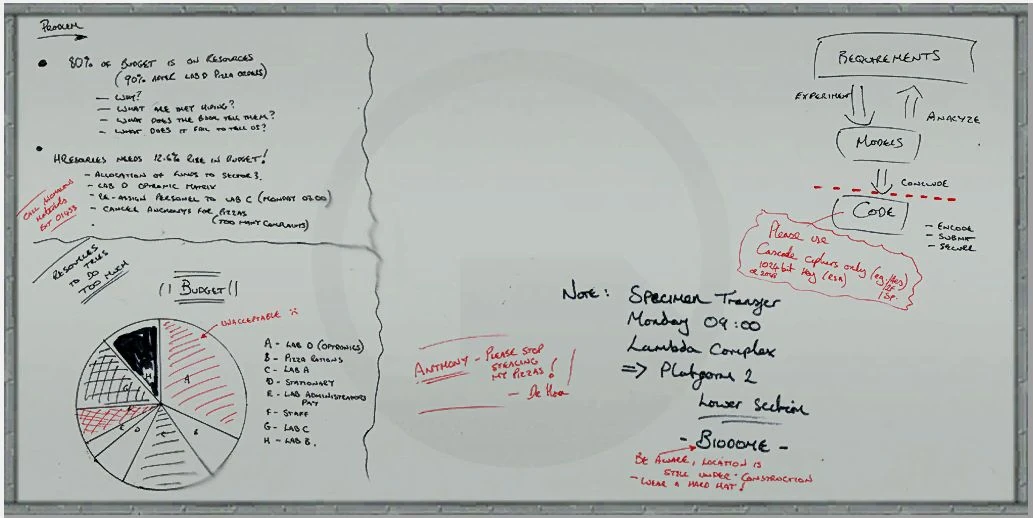
This whiteboard is our answer, hands down, no questions asked. I’ll tell you why I’m convinced:

  1. The message on the “LIES.jpg” image that says “Steals it, eats it” and mentions Stone will pay is a direct reference to the board’s message: “Anthony - please stop stealing my pizzas!”
  2. The pie chart lists Lab D (optronics) as the biggest budget sink–this is a direct reference to our last gate puzzle.
  3. The red dashed line is so obvious as to be a blaring neon sign. Below, it clearly says “code” and says to use cascade ciphers only. Now, Storm directly messaged me (posing as 0418) that he thought it would be one of those, but I think he may have simply been pointing me/us toward this whiteboard. I think the true answer lies within the RSA on the board, and this was simply another arrow pointing toward it.
  4. The RSA encryption suggestion on the board is a direct reference to our “BENALOHPAILLIER” hint. Unpadded RSA is partially homomorphic, and both Benaloh and Paillier are homomorphic cryptosystems.
  5. The message at the bottom of the whiteboard is exactly 1024 bits (128 bytes) if you include punctuation and remove spaces: Note :s pecimentransfermonday09:00lambdacomplexplatform2lowersection-biodome-beawarelocationisstillunderconstruction-wearahardhat! This may pointing us directly at RSA as the method for solving the hex code, but it could also be a coincidence.
  6. Storm mentioned that he thought the hex was a secondary encode. This would make sense if the RSA method is used, for the initial ciphtertext output would be in numerical format.
  7. Storm also mentioned that the CIA couldn’t bruteforce it. Some traditional symmetric ciphers can’t legitimately be bruteforced, but neither can RSA.
    The key problem I see with this method is that our key would need to be quite large, at least 4096 bits. This is because the size of the ciphertext is quite large, and in traditional RSA the message cannot be longer than the key size (and is 11 bytes shorter with padding). Or, we may be dealing with hybrid encryption, wherein the message itself is encrypted with a block cipher, but the key is encrypted with RSA.

Whatever the case, I know for a fact that this whiteboard holds our answer.
…^^^
EDIT: I figured if I sounded confident enough, the ARG would break and reveal its answers to us.

I haven’t seen this mentioned before, I’m sorry if someone did. The Black Mesa devs recently spent an hour playing Rocket League and streamed it through Twitch. I haven’t watched the stream, I have not the slightest clue what they might say in it, but maybe it can help any of you smart ARG solvers :3

https://www.twitch.tv/blackmesagame/v/20834190

While I agree that that whiteboard should be where our focus needs to be…

…I’d like to hear some theories as to why this other whiteboard would be significant? See the red note from Dr Horn to not erase this board? There are two other instances where Dr Horn wanted the board preserved, and for good reason, too. Maybe there’s something else important on that board, hidden among the formulas and calculations?

Good call, man. Taking a look at them . . .

This one is important for a couple of main reasons:

  1. It mentions isotopes of promethium/neodymium being unstable, which may be referenced by the list of isotopes of niobium that were posted on the wiki.
  2. We already know that Storm was proud of the Laser Optronic Linear Inducer Cannon (so much so that he trademarked it in his BM wiki profile) and that it was used to solve Code D. On this board, we have “Accelerated Lepton Optronic Linearity Cannon.”
  3. We also have a (possibly coincidental) reference to niobium with the message to the right of the board: “Possibility of quantum pulse detonation.” We already mentioned before that niobium is used in quantum computers. It also mentions Dr. Welsh is looking into it with an odd ellipse (" . . . ") at the end.
    The whiteboard you mentioned also has some key reasons it might be important:
  4. It too mentions leptons.
  5. The Higgs-TauTau is a reference to the Higgs boson and its decay into tau leptons. Furthermore, the cannon is also called the “Tau cannon.”
  6. Yet another reference to the cannon: “Interesting side effect of neodymium optronic causeators”–I’m pretty sure it says “causeators,” but it might be some other word.
    This board also particularly interests me for three key reasons:
  7. It has a note directed at Paul Bottomley about the Niobium 5 needed for that “AI project thingy.” I know we have noted this before, but have we ever bothered to take a look at the rest of the whiteboard?
  8. It makes mention of the EP-0021.
  9. The extension is split into two by the period. Both of the numbers “1187” and “463” are apparently prime–at least if the prime calculator I’m using is to be believed.
    The extension 01433 (assuming it is 01433, it could also be 01633) listed on the budget whiteboard is also prime–again, at least according to the calculator.

That leaves us with three prime numbers: 1187, 463 and 1433. If any of these are not prime and the calculator was wrong, please let me know. I’ll do some experimenting with these numbers to see if I get anything interesting.

EDIT: Don’t forget that the first 8-digit segment of the Codes A - D number is also prime: 10010851.

The only problem with these numbers is that they don’t produce an N anywhere near large enough to encode the entirety of the hex file. Not even close.

EDIT2: I think this is the most significant issue with this portion of the ARG. Having tough puzzles like the one Storm mentioned in the IRC channel–wherein cockroaches crawling on the ground in one portion of the ARG he attempted created an image when their movements were mapped–are a great way of fueling and maintaining interest in an ARG. I imagine something pointed to that section of the game in some way, and it then became a matter of determining why and how those cockroaches were important. I sincerely don’t want to sound like I’m complaining here, and I hate to say it, but I think this portion of the ARG has become too synthetically hard; and it’s not for lack of design choice on Storm’s part. Rather, it’s our own faults. We have developed so many ideas and dug up so much information that we have weighed ourselves down with countless possibilities. Every attempt I have made to circumvent all the ideas and start at square one has ended with me thinking, “Well, what about this portion? How about that idea? Did we try X . . . Y . . . Z?” In other words, we have created a monster that will be, quite frankly, impossible to solve without the creator helping us eliminate some threads. I don’t know if and how he might do this, but I sincerely doubt we are going to make headway without it.

The other reason for this is that we are potentially dealing with heavy-handed cryptography. We are dealing with something that cannot be partially decrypted with guesswork (like the OTP puzzle)–we either nail it down 100% or we fail with 0%. At least with that cockroach puzzle, even as incredibly difficult as I’m sure it was to figure out the method, a partial image constructed by accident from the movements still would have produced something. Again, I don’t want to sound like I’m complaining–this is not Storm’s fault in the slightest, but a conundrum created by our own shared ambitions. However, I sincerely hope that the next puzzles are a little more geared towards puzzles that cannot be accidentally corrupted by sheer number of minds involved.

In essence, I believe that a “reboot” of sorts, or a set of directions that re-targets our efforts, is definitely in order. Again, I don’t want Storm to be irritated by what I’m saying–I’m not complaining that the ARG itself is too hard, just that we have created something so huge that we can’t possibly constrain it to fit our process of determining a valid solution.

My very first ARG was in the March issue of GamePro back in 2003. The GamePro Enigma spanned the entire magazine and had a couple small online elements, yet the fact is that it was contained within the magazine itself. Although anything and everything within that magazine could be a part of the greater puzzle, there was no trepidation that some random outside information was needed. I managed to solve it far before the cutoff date (the answer was “syzygy”), but it definitely took a lot of backtracking, double-checking and guesswork. That, to me, is what makes these things so damn fun. You never know that you’re on the right track until you get the chance to check your work–and then you realize what you’ve accomplished! Solving Code D was like a huge breath of fresh air, and my heart was pumping so hard when I wrote that post those few years ago. I really want that feeling again, and I know we can do it. We simply need to create a construct that we can work within knowing (at least partially) that the answers we need are contained within it–and we may need help doing that. Determining the answer by diligently chipping away at something is one thing, but randomly guessing and checking (without at least some direction) is something else entirely.

Storm, I love you. Please don’t take this the wrong way. Again–not your fault, man.

EDIT3: Just a fun little puzzle if you want to take some of the edge off: https://enigmapuzzle.fizzlebot.com/

Great analysis Gunsrequiem.

I do feel that we might have overlooked the information in many of these white boards.

As a result, i do feel that there is still some something undiscovered in Questionable Ethics as well as in the other chapters.

Another thing, this is the first ARG that i have participated in and so far it has been a very fun time being here.

Founded in 2004, Leakfree.org became one of the first online communities dedicated to Valve’s Source engine development. It is more famously known for the formation of Black Mesa: Source under the 'Leakfree Modification Team' handle in September 2004.